Return/refund claims: how to prepare evidence that gets approved

A return or refund claim isn’t decided by who is right, but by who has clearer evidence. In the same situation, a seller who submits complete photos, videos and shipping history is usually treated more favorably than one who only replies “I sent the right item.”
1.Why evidence decides the outcome of a claim
Every seller who has been online long enough has been through it: a buyer receives the order and reports it as missing items, wrong items or damaged, or sends back something that isn’t yours. The cost of the goods, shipping both ways and your shop’s reputation are all on the line. The good news is that most of the evidence can be prepared in advance, right when you pack the order and hand it to the carrier. This article collects practical tips so your claims are shorter, complete and more convincing.
2.What evidence you need in each case
Not every order needs the same set of evidence. Knowing in advance what each situation requires saves you from filming too much and, more importantly, from missing the one thing you need.
| Situation | Evidence to prepare |
|---|---|
| The marketplace refunds the buyer on its own, no return needed | A packing video is enough |
| The buyer returns the item but it hasn’t reached you yet | No evidence needed |
| The item comes back broken or damaged | Packing video and return unboxing video; if the parcel is deformed (torn, wet...), add a joint inspection report |
| The item comes back with missing products, gifts or accessories | Packing video and return unboxing video |
| The item that comes back isn’t the one you sent | Packing video and return unboxing video |
| The item comes back intact but you disagree with the buyer’s reason | Return unboxing video |
| You are suspected of selling counterfeit or fake goods | Documents proving the goods are genuine are mandatory |
Looking at the table, the packing video and the return unboxing video show up almost every time. Make both a habit for every order.
3.7 tips for submitting evidence that improves your chances
1. Film a packing video for every order
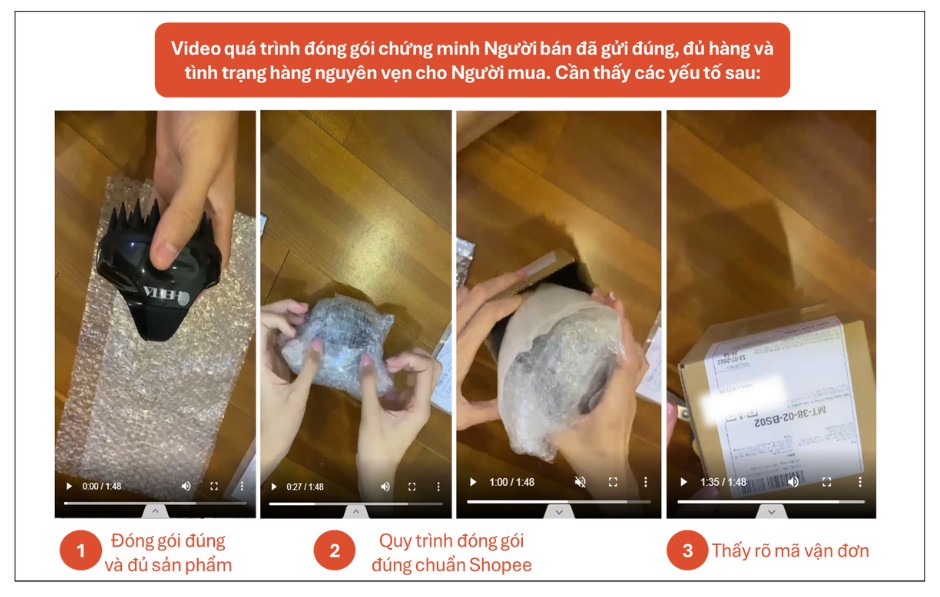
This is the fastest way to prove you sent the right item, in the right quantity, in intact condition when it left your hands. Film it before handing the parcel to the carrier, in one continuous take with no cuts or editing. The frame should show:
- The order number
- The correct product, in full quantity, with no scratches or defects
- The packing steps, done to standard
- The tracking number stuck on the parcel, clearly legible
2. Photograph the product and keep proof of origin
Before sealing the box, photograph the product from its main sides, along with labels, serial numbers or batch codes if there are any, in good light and in focus. If you sell a category that is often suspected of being counterfeit or fake, gather proof of origin in advance, such as VAT invoices, customs declarations, brand registration certificates or distribution contracts, depending on your role in the supply chain. Keep it all in one folder so it’s ready when you need it.
3. Keep complete shipping records
Keep the tracking number, the handover time, the carrier and the full journey of the parcel. This lets you prove the goods reached the right recipient at the right time, and cross-check the status of a returned order when a dispute comes up. If you ship with several carriers, collecting the tracking numbers of all of them in one Allingo dashboard saves you from opening each carrier’s app to look them up.
4. Keep every conversation with the buyer on the official channel
Commitments about design, size, color, delivery time or the return policy should all stay in the marketplace’s chat, not move to a private channel. Take screenshots of important conversations, especially where the buyer confirms receipt or agrees to a resolution.
5. When a return arrives: film the return unboxing video right away
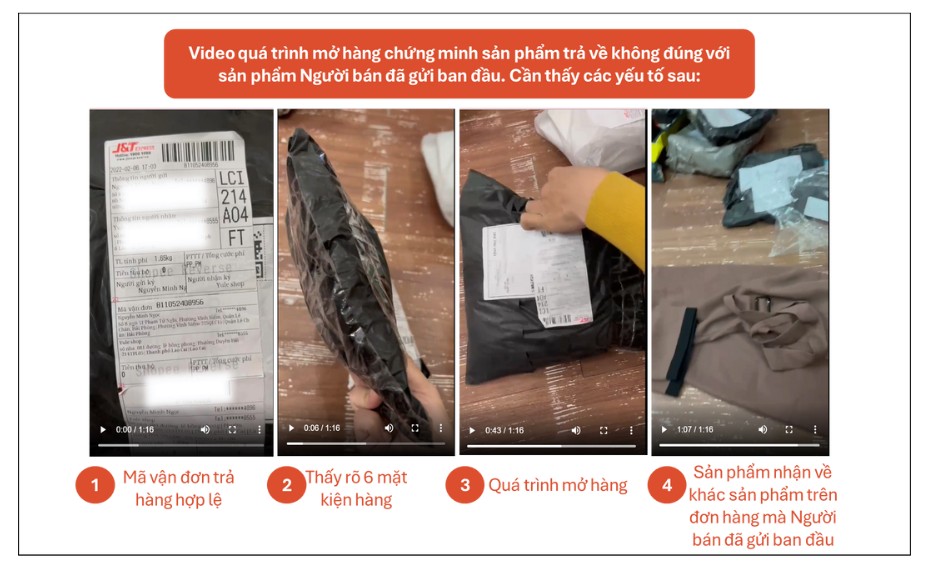
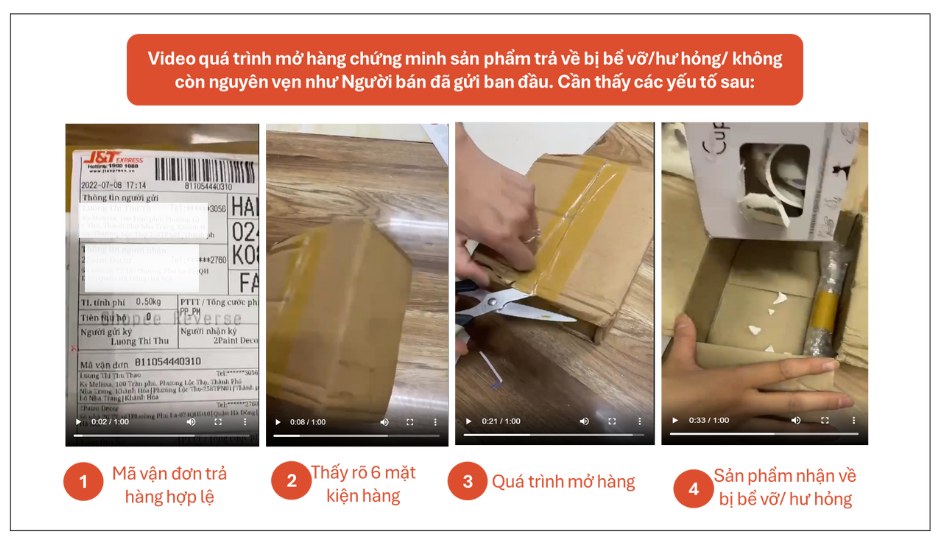
This video shows that what came back is different, incomplete or damaged compared with what you sent. Film it the moment the parcel reaches you, before doing anything else. The frame should include:
- The return tracking number and the order number
- All 6 sides of the parcel
- A continuous shot of opening the parcel, with no breaks
- The real condition of the goods: different from what was sent, broken, damaged, or missing items/gifts/accessories
Some situations need extra evidence:
- Electronics reported as not working: also film yourself testing the device.
- The parcel arrives torn, wet, punctured...: add a joint inspection report signed by the postman and the recipient.
- The goods come back intact and you disagree with the buyer’s reason: the return unboxing video is enough.
6. Cross-check COD and payment
For COD orders, check whether the order was delivered or returned, the amount collected and the reconciliation date. Many small disputes turn out to be mismatched numbers, not product problems. A clear reconciliation record lets you argue with numbers instead of impressions. With Allingo, COD, tracking numbers and finances from all carriers sit in one account, so cross-checking takes less manual work.
7. Present your claim concisely, in order, and stick to the facts
Good evidence presented in a mess can still be overlooked. A good claim should include:
- Order number, order date, ship date, and the date received or returned
- The problem the buyer reported and what you actually found when you checked
- A list of attached evidence, with clear file names (for example: DH123_packing-video)
- A specific request: how you want the marketplace to resolve it
Keep the tone calm, state the facts and don’t blame anyone. The person handling claims reads a great many each day, and a clear one gets a closer look.
Whichever video you film, keep it continuous, sharp and unedited. That decides whether your evidence is accepted.
4.Quick checklist for every order
- A continuous packing video, with the order number and shipping label clearly visible
- Product photos before shipping (sharp, well lit, with label/serial number if any)
- Tracking number and journey history saved
- Conversations with the buyer kept on the official channel
- For returns: film the unboxing right when the parcel arrives
- For COD orders: cross-check delivered/returned status and the amount collected
- Claim submitted on time, written concisely, with all files attached
5.One small habit that makes the difference
Good evidence mostly comes from habit: film, photograph, save and cross-check as you process each order, not after a dispute starts. It costs a minute or two per order, but when you need to file a claim, you have everything on hand instead of digging through old messages.
If you ship many orders with several carriers, keeping tracking numbers, COD and reconciliation in one place also helps you pull up information faster when you need it. Allingo is a multi-carrier shipping platform for online sellers: connect once, ship with every carrier, and manage COD, tracking and reconciliation in one place.
References
- Seller Education Hub: guide to submitting evidence for return/refund claims (in Vietnamese)
- Illustrations: Shopee